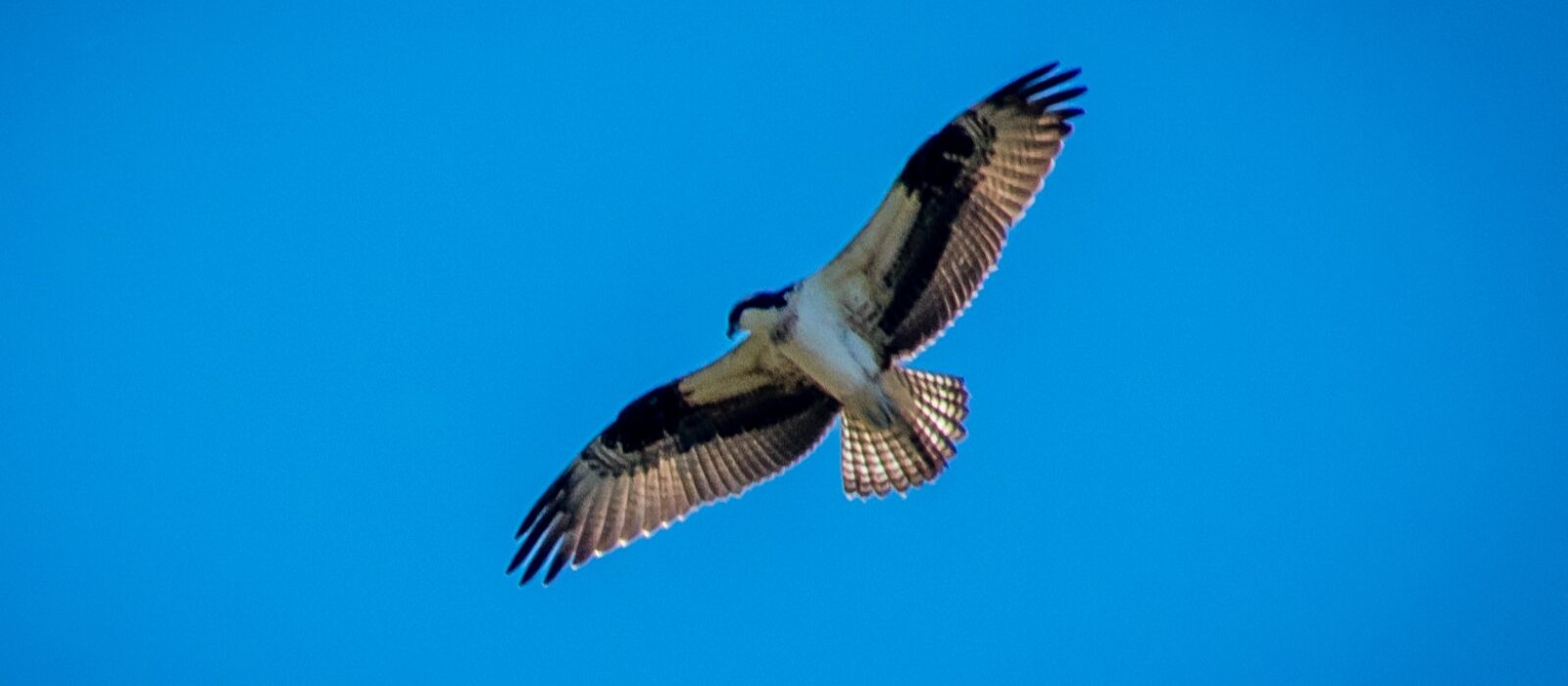
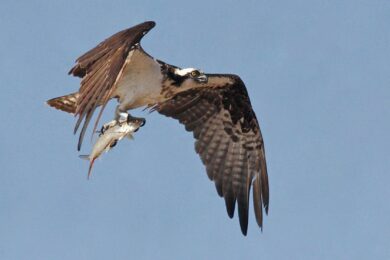
Photo: USFWS
Martha’s Vineyard Ospreys Flourish Amid Regional Decline
Along the Atlantic coast, south and west of the Vineyard, Ospreys (Pandion haliaetus) are raising their wings and letting us know that we are doing something wrong, and they’re not happy about it.
Beginning in the early 2020s, researchers studying Ospreys in Chesapeake Bay, where more than 12,000 pairs of Ospreys are thought to nest every spring — the highest density of the species anywhere on the planet — realized that Ospreys were having difficulty raising their young. The last two years have been especially disastrous for Chesapeake Bay Ospreys: reproductive rates have declined to levels well below what is needed to keep the population stable.
Even worse, the problem is not restricted to Chesapeake Bay. Coastal populations from Virginia to Buzzards Bay are suffering the same plight. Young are starving to death before they can fledge.
Sixty years ago, Ospreys, Peregrine Falcons (Falco peregrinus), and Bald Eagles (Haliaeetus leucocephalus) sent us another message. And while the circumstances then and now are quite different, the role of the island of Martha’s Vineyard in today’s crisis curiously echoes what happened six decades ago.
One summer day in the early 1960s, the famed field guide author and artist Roger Tory Peterson looked out over the famous Osprey colony at the mouth of the Connecticut River at the peak of the nesting season. Scanning dozens of Osprey nests from one spot, as one could back then and can again now, he counted the number of young in all those nests with just a couple of the fingers on one of his hands.
Along the southern coast of New England, Osprey numbers plummeted from more than 1,000 pairs in the 1940s to just over 100 by the late 1960s. At the same time, falconers compared notes and realized that there were no peregrines nesting east of the Mississippi River. Bald Eagles were disappearing. Brown Pelican (Pelicanus occidentalis) numbers were plummeting. Something was clearly going wrong, and all those species were letting us know about it.
We got the message. It took a few years, but a group of researchers deciphered the signal. The apparently miraculous insecticide DDT was very effective at killing mosquitos and did not have any noticeable effect on humans, so we dumped tons of it on our marshes to suppress mosquito populations. But the chemical does much more than kill mosquitos. It is persistent in the environment and thus multiplies upwards through food chains, eventually interfering with the reproductive system of female birds atop long food chains — like Ospreys, Peregrine Falcons, and Bald Eagles. So in 1972, the use of DDT was banned in the United States. The resounding rebound of those once-declining species in subsequent years was a tacit “Thank you for sorting that out.”

Photo: USFWS
During those dark years of the DDT crisis, the Ospreys on Martha’s Vineyard were an odd outlier. In the early 1970s, there were only two pairs of Ospreys nesting on the island. But each pair was successfully raising three or four young every year. In three years, the two pairs fledged a total of 24 young, which may have equaled the total number of young produced by all the Ospreys nesting around Long island Sound in a single year.
That was perplexing for two reasons. Why were the Vineyard Ospreys reproducing so well when almost everywhere else, the species was in a precipitous decline? And why were there only two pairs of Ospreys on the island when those birds were so prolific?
The answer to the second puzzle was unraveled when the late Gus Ben David, the godfather of Vineyard Ospreys, found out that the local line crews had been removing Osprey nests from power lines for a number of years. Just doing their job. Gus arranged with Cape and Islands Power to let him know when a pair of Ospreys was building a problematic nest on a power line. Working with Gus, the line crews set up safe poles close by and then knocked the dangerous nests down. The birds quickly moved to the new poles, which were just a bit taller than the poles the Ospreys had started to build on. Ospreys are suckers for a room with a view. They like to nest on the tallest thing around, so the new, taller poles were irresistible. (So are cell towers these days.)
It took a bit longer to figure out why the Vineyard Ospreys were so successful at raising young in those difficult times. It turns out that the Vineyard stopped spraying DDT on our marshes back in 1958. It had nothing to do with conservation but everything to do with money. The towns couldn’t afford to pay for helicopters or planes to spray DDT. By the late 1960s and early 1970s, whatever DDT had been sprayed on the island had become sequestered in soil and sediment, and the two pairs of Vineyard Ospreys had an island full of DDT-free fish — a self-contained, all-you-can-eat Osprey heaven.
Once Gus’s program of providing safe nest sites got rolling, the Vineyard Osprey population exploded. In 2026, there were more than 160 pairs nesting on the island — either established pairs raising young, or “newly-wed,” inexperienced pairs working on starter nests.

Osprey chick under a rehabber’s care. Photo: USFWS
So, what’s going on with the current crisis? In the 1960s, Ospreys and the other declining raptor species tainted by DDT were laying eggs that didn’t hatch. In the 2020s, in contrast, Osprey eggs are hatching, but the young are starving. Moreover, the DDT-related population crashes were continent-wide, while the current crisis is limited to the bays and coastal habitats of the mid-Atlantic states and southern New England. Inland Ospreys are doing just fine.
This time the cause of the crisis is easier to figure out but may be harder to resolve. The key to the mid-20th century collapse of a suite of raptor species was DDT. The key to the 21st century collapse of Osprey breeding success is a small, oily, plankton-feeding fish. Atlantic Menhaden (Brevoortia tyrannus), or “bunker” as they’re generally known on the Vineyard, are foot-long, nutrient-rich ocean fish that form enormous schools and are the keystone prey species for a remarkably diverse suite of fish-eating predators. Not just Ospreys but Bluefish (Pomatomus saltatrix), Striped Bass (Morone saxatilis), tuna, sharks, dolphins, and even Hump-backed Whales (Megaptera novaeangliae) rely on menhaden as an essential part of their prey base.
The menhaden’s high nutritional qualities make them attractive to humans as well. Not as something to eat — they’re too bony and oily for our palates — but rather as a source of food for fish farms, bait for other commercial fisheries, and Omega-3 natural oils for dietary supplements. A once-widespread commercial “reduction fishery” ranged up and down the Atlantic coast and down into the Gulf of Mexico. Reduction fisheries don’t sell fish whole but rather grind up their catch, reducing the harvested fish into raw material for diverse commercial products.
Now only one plant, owned by Omega Protein, is harvesting and processing menhaden from the Atlantic bays and coastal waters. The plant is in Reedville, Virginia, and its associated fleet of fishing trawlers and spotting planes annually takes between 136,000 and 151,000 metric tons of menhaden out of the ecosystem. When a school of menhaden is located, the trawlers remove essentially every fish — often numbering in the millions — from the water.
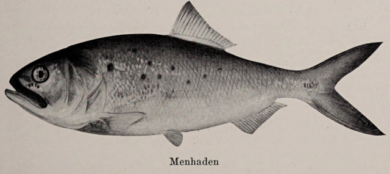
Atlantic Menhaden
While harvest quotas are set by the Atlantic States Marine Fisheries Council, these quotas, according to many stakeholders in the Chesapeake, are depressing menhaden numbers to the point that there simply aren’t enough menhaden available for Ospreys in the critical period in late spring, when the young are in their maximum growth phase. Others argue that the problem is timing, and menhaden are still appearing plentifully in the Chesapeake, but not when the Ospreys need them most. Maybe this disconnect is related to climate change.
Regardless of the precise cause, or causes, 60 years after the DDT crisis we are once again in a situation in which the reproductive success of the Vineyard Ospreys is outpacing that of birds nesting anywhere else along the northeast coast. What does this tell us?
Ornithologist Alan Poole, who probably understands Ospreys better than any other researcher on the planet, has been studying an Osprey colony at the mouth of the Westport River for more than 20 years. The Westport colony is only 20 miles from Martha’s Vineyard. Poole’s study population, which numbers about 100 pairs tightly packed on about 20 square miles of marshy islands at the mouth of the two forks of the Westport River, has had two terrible years in a row. Poole and his team have documented colony-wide starvation of young. Similarly, Kevin Friel, who monitors the Ospreys nesting on upper Cape Cod around Falmouth, has seen poor reproductive success over the past two years.
While those Ospreys have been struggling to raise young, the Vineyard Ospreys have been doing swimmingly. 2025 was our second-best year and 2026 was the fifth-best year since we started tracking the reproductive success of the Vineyard birds in 1998.
What’s the difference? Once again, Martha’s Vineyard has proven to be a self-contained osprey heaven. Our shallow bays — Katama and Cape Pogue — and our shallow water bodies such as Lake Tashmoo, the Lagoon, Chilmark, Tisbury, and Edgartown Great Ponds, and Menemsha and Squibnocket Ponds, are exactly what an Osprey planning committee would have designed for themselves. The data show that there are enough fish on the island to support a thriving population of more than 160 Osprey pairs — and that is likely an underestimate.

Vineyard Osprey foraging patterns. Image: Rob Bierregaard
Menhaden are certainly part of the Vineyard Ospreys’ diet when available, but they’re not the crucial part, as they appear to be along much of the Atlantic coast, even in populations just 10 or 20 miles away. One year, one of our tagged adult males, Icarius, who nested at Long Point on the south shore, spent much of early July feeding on menhaden up to four miles off South Beach. But Vineyard Ospreys appear to have alternatives, like Scup (Stenotomus chrysops) and Yellow Perch (Perca flavescens), that give their diets flexibility. My own satellite tracking data for Vineyard Ospreys shows that they generally don’t leave the Vineyard to forage. One of the Ospreys I tagged on the Westport River commuted more than 20 miles to Narragansett Bay to hunt. Vineyard Ospreys, in contrast, don’t seem to need to fly even five miles across Vineyard Sound to Cape Cod.
Ospreys occur around the world, so a crisis along the Atlantic coast isn’t a serious threat to the species, which occurs worldwide. But it once again shows us that we have knocked a large aquatic ecosystem out of whack and should be finding ways to make amends.
And it also shows that, if you were an Osprey, you’d want to wind up nesting on Martha’s Vineyard.
Further Reading:
Bruce Franklin’s marvelous book, The Most Important Fish in the Sea: Menhaden and America. (If you listen to books, get this from Audible. The author narrates it, and, while it’s not a very polished production, Franklin’s passion for the topic rings loud and clear.)
The Washington Post covered the news from the Chesapeake as researchers raised the alarm: https://www.washingtonpost.com/climate-environment/2026/09/27/ospreys-are-disappearing-along-east-coast-scientists-think-they-know-why/
Read more about the issues on the Chesapeake Bay Foundation’s website: https://www.cbf.org/nature/atlantic-menhaden/
Rob Bierregaard began his 50-year career as an ornithologist studying birds of prey on Martha’s Vineyard. In the early 1970s, Rob’s research focused on Northern Harriers, American Kestrels, and Ospreys. In 1998, he revived the Vineyard-wide Osprey census that Gus Ben David had done until 1994. The 2027 census will be the 30th under Rob’s direction. Over those 30 years, the Martha’s Vineyard Osprey population grew from just under 70 pairs to more than 160.