
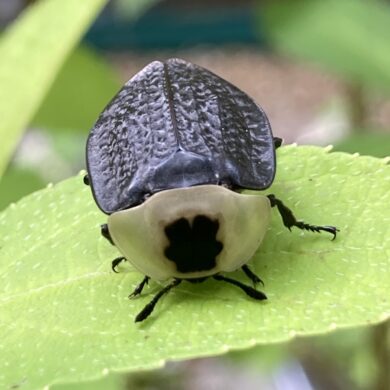
American carrion beetle, Necrophila americana. Photo: Sharon Britton
Carrion Beetles of Martha’s Vineyard
The subfamily Silphinae — the carrion beetles — have a bit of a public relations problem. As the common name of this group suggests, these insects, taxonomically nested in the very large and complex family that also includes the rove beetles, associate closely with dead things. And the negative connotations and often pungent aroma resulting from that association keep many observers from paying much attention to these beetles.
But as part of nature’s recycling corps, carrion beetles play important roles in the environment. And beyond their fondness for carrion, this group exhibits some truly fascinating biology. The Vineyard’s carrion beetles are not a highly diverse group, with only eight species in three genera known from the island. But they deserve more attention from naturalists.
For one thing, the use carrion beetles make of dead animals varies from genus to genus. Our five sexton beetle species — the genus Nicrophorus — generally lay their eggs on the carcass of a small animal, then bury the carcass by excavating the soil from underneath it. Adults, in one of the few known instances of parental care among insects, feed their young pre-digested, regurgitated carrion. Bugguide.net reports that sexton beetles even modulate the rate of decay of carrion, presumably to keep it in prime eating condition, by applying anti-microbial saliva to slow decomposition. An exception to this pattern is said to be N. pustulatus (the Vineyard recently logged its first iNaturalist observation of this species): this species is a brood parasite, laying its eggs among the eggs stashed by other sexton beetles and, reportedly, sometimes parasitizing reptile eggs.
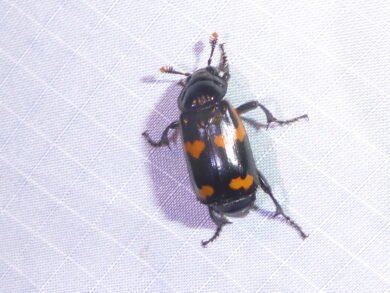
Nicrophorus sayi, photographed at a moth sheet. Photo: Dave Small
With only about 15 North American species, Nicrophorus is a very manageable genus to study. Like all of the Vineyard’s carrion beetles, our members of this genus are robust insects about an inch in length. With the exception of one all-black species found in the western United States, sexton beetles have distinctive patterns of orange or yellowish spots on their otherwise black forewings. Working from a decent photograph, or sometimes even just from a good view in the field, those markings generally suffice for species-level identification.
I am unable to find any firm historical (much less recent) Vineyard records for the American burying beetle, Nicrophorus americanus (not to be confused with the locally common American carrion beetle, discussed below). Once a common and widespread species, this insect has vanished in much of its historical range, and it is currently listed as “Endangered” under both the Federal and Massachusetts Endangered Species Acts. A population on Block Island appears to be the only known naturally occurring remnant of this beetle in New England, though reintroduction projects have attempted to (re)establish it elsewhere. This sexton beetle appears to be fussy about the size of the carcasses it feeds on, and by one theory, the decline of this beetle was triggered by the extinction of the (perfectly sized?) passenger pigeon, Ectopistes migratorius (in 1914, though the species had become functionally extinct in the wild well before that). A state web page provides a useful and interesting summary of the status of this beetle. The odds are encountering this species on Martha’s Vineyard are essentially nil — but hope springs eternal, and I certainly keep an eye out for this distinctively marked insect.

American burying beetle, Nicrophorus americanus, photographed in Nebraska by Drew Granville. https://www.inaturalist.org/photos/415846905
Members of our other carrion beetle genera, Oiceoptoma and Necrophila, are also found on carrion. Necrophila is represented here by just one species, N. americana, the American carrion beetle. This is a distinctive and fairly common beetle, easily identifiable by its broad, yellow, flanged pronotum marked with a central patch of black. The Vineyard hosts to Oiceoptoma species, the all-black O. inaequale, or ridged carrion beetle, and O. novaborecense, which has a distinctive reddish margin around its pronotum, suggestive of a pattern commonly shown by (unrelated) fireflies and several other beetle groups. Neither species appears to be common on Martha’s Vineyard. They elytra (the hard forewings) of both of these species are marked by longitudinal ridges, vaguely suggestive to my of of the ridges found on a leatherback sea turtle. So there is little chance of misidentifying these beetles. Instead of or in addition to eating the carrion itself, beetles in these genera also consume fly larvae feeding on the carrion. Even fungi may form part of their diet, according to information provided on Bugguide.net.
Many of our carrion beetle species turn up routinely at blacklighting stations set up for moths, affording opportunities for photography and close observation that don’t require getting close to a decaying carcass. Carrion beetles sometimes even turn up at porch lights.
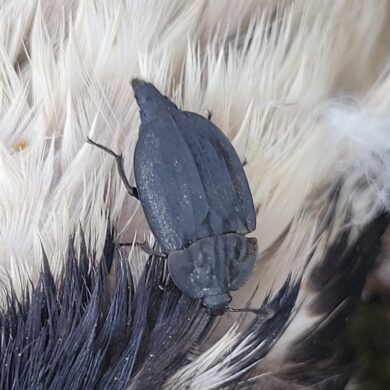
Ridged carrion beetle, Oiceoptoma inaquale, frolicking on a dead Canada goose.
Another odd feature of the carrion beetles is their frequent association with so-called “phoretic” mites. The mites, which prey on the same fly eggs and larvae the represent competition for carrion beetles at carcasses, lack wings and hence have limited mobility. But they hitch rides on carrion beetles, which fly just fine, thereby getting transported to new carcasses. The mites don’t feed or in any way damage the beetle; this is simply a case of symbiosis in which unrelated species trade transportation for the suppression of competitors.
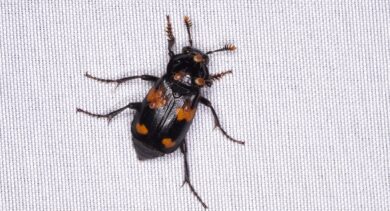
Round-necked sexton beetle, Nicrophorus orbicollis, carrying several phoretic mites.
So although I understand the aversion that many observers may feel toward these beetles, I view carrion beetles as an essential and interesting component of the Vineyard’s insect fauna. And I will continue to search every bird or mammal carcass I encounter in the hope of finding some of these beetles.
Matt Pelikan is the community naturalist at BiodiversityWorks. He has lived full-time on Martha’s Vineyard since 1997.