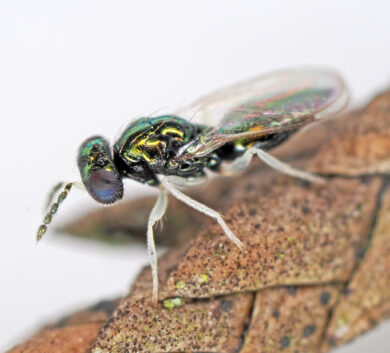
Horismenus sp., one of Chris Baer’s recent finds.
6,000 Species!
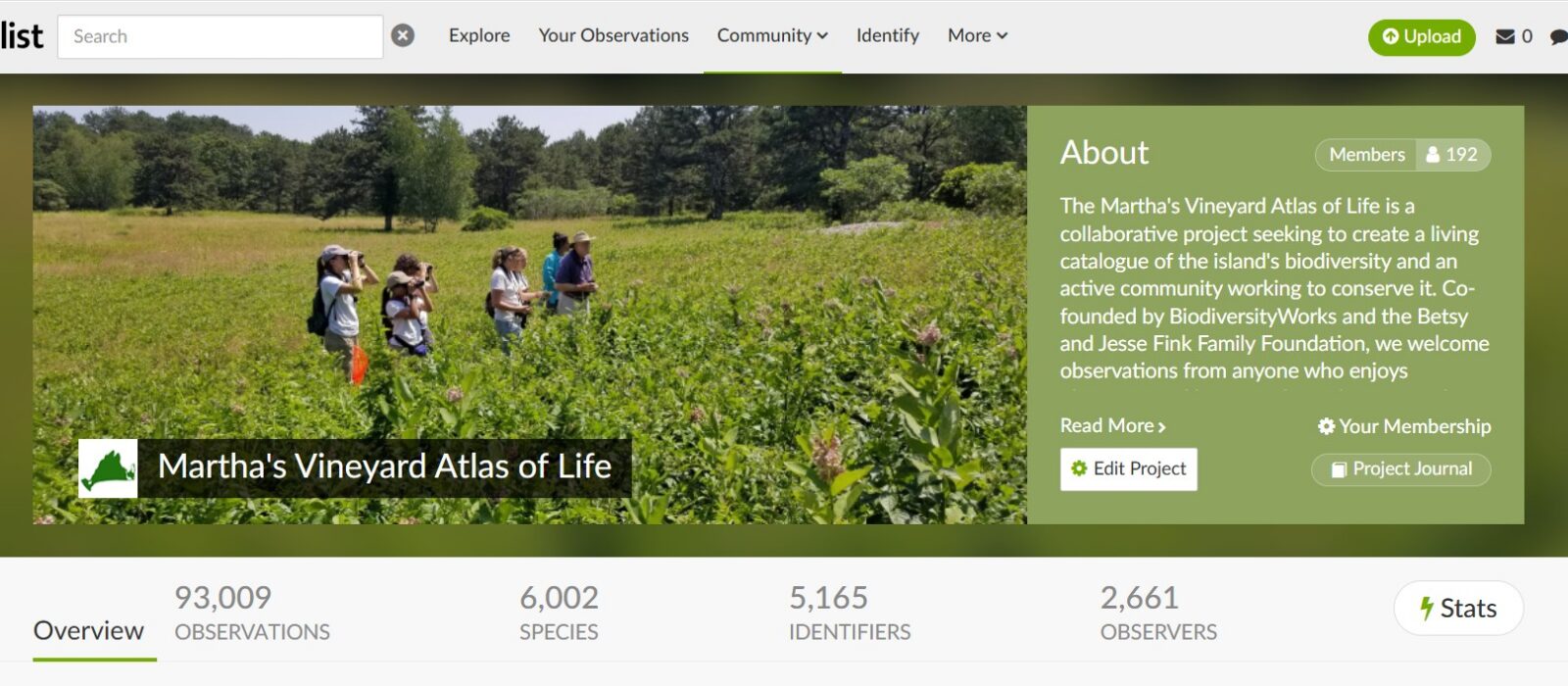
A central component of the Martha’s Vineyard Atlas of Life (MVAL) is the iNaturalist project bearing the same name. The project automatically collects all verifiable observations (that is, observations supported by photographs or sound recordings) from Martha’s Vineyard, making use of the extensive capabilities built into this powerful community science platform. The user-friendly web and phone interfaces of iNaturalist give observers a fun and easy way to record their sightings. The artificial intelligence capabilities of iNat, augmented by input from a worldwide network of experienced naturalists, assists with identification and maintains data quality. Like any database, iNaturalist offers powerful tools for selecting and analyzing data. The Vineyard observations that more than 2,600 naturalists have contributed represents a wealth of information, available to anyone and useful for a wide range of products including the production of many of the checklists that appear on this website.
Sometime during the night of November 19–20, 2026, the MVAL iNat project hit a significant milestone when the 6,000th species was entered. (The count appearing when you look may be different; as a project administrator, I may be able to “see” some observations that you cannot.) Species counts in iNaturalist can fluctuate as identifications are refined or corrected, so it’s impossible to say for certain what observation put us over the mark. The 6000th species could even have been an old observation, with its identification upgraded by one of the thousands of iNaturalist users who contribute to the naturalist community by reviewing observations both old and new. But if I had to guess, I’d say that it was probably an observation by Chris Baer that took us to the milestone. While he is a relatively new iNat user and a relative beginner as a naturalist, Chris’s photographic skills and uncanny ability to find interesting invertebrates have made him a leading contributor — probably THE leading contributor — to the project over the past year or so.
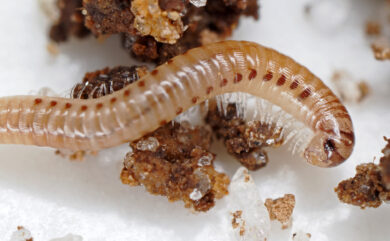
Thin snake millipede (Blaniulidae). Photo: Chris Baer
The figure of 6,000 is by no means an endpoint. The species count has already crept up from there and will certainly continue to increase for the indefinite future. I don’t know how many species actually occur on Martha’s Vineyard, but even that number (whatever it is) is provisional: new species are arriving all the time. Additional species, to be sure, will likely become harder to find as time goes by. But counteracting that effect is the steady increase in the number and activity levels of local iNaturalist users.
The rate at which species have accumulated in the iNaturalist MVAL project is worth a closer look. On the face of it, you’d expect the rate of addition to slow down over time, as the most common, most obvious, and most easily photographed species get documented. But the number of iNaturalist users continues to grow briskly, because even as new species get harder to find, more people are out there looking. So to date, the growth of the MVAL species count has been pretty close to linear.
The project hit the 3,000-species mark late August 2022. At the time, fewer than 20,000 observations resided in the project, compiled by a litte shy of 1,300 observers. We hit 4,000 species just over a year later, in October 2023, and then 5,000 in late August 2025, by which point about 2,200 observers had contributed at least one observation. As the species count and number of observers grew, so did the level of skill and motivation exhibited by those observers. Events like the epic Inter-Island BioBlitz of the summer of 2026 inspired greater iNat activity in scores of observers, and the bump in productivity that this created is still very much evident. I’m willing to predict that we’ll hit 7,000 species by the end of 2027, or at worst early in 2028!
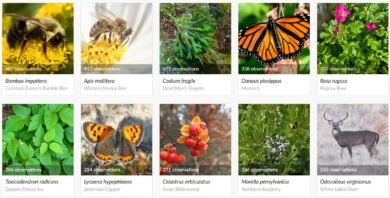
We might also look at the most frequently observed species in the MVAL project. Predictably, this list is stacked with common, widespread, and appealing species such as the monarch butterfly and the white-tailed deer. But it’s also clear that particular circumstances can affect the frequency of observation, meaning that the relative abundance of species in the project cannot be assumed to reflect relative abundance in the real world. For example, the two leading species, Bombus impatiens and Apis mellifera, probably benefited from a three-year study of pollinators on farms conducted by BiodiversityWorks, the Betsy and Jesse Fink Family Foundation, and eight Vineyard farms. These bees were ubiquitous on the particpating farms, and since iNaturalist was the main data collection tool used in that study, hundreds of observations of both of these bee species were entered, boosting their representation in iNaturalist.
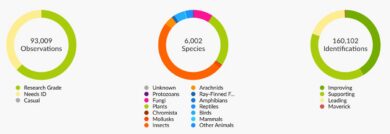
Looking at the taxonomic breakdown of the project’s 6,000 species, I take a certain amount of pleasure in noting that insects — my main interest — are very well represented, consituting roughly half of the species documented. Insects, of course, are a hugely diverse class; but I like to think that my proslytizing on their behalf has encouraged others to focus on this group. Plants, vertebrates, fungi, and spiders also figure prominently in our species list.
Finally, it’s worth thinking about the structure of the community of observers that drives the MVAL iNaturalist project. Currently, about 2,660 observers have contributed at least once, with their combined efforts adding up to more than 93,000 observations. But the observations are not evenly distributed among those contributors. Only 13 have contributed more than 1,000 observations; just 105 have produced 100 or more; and just 280, or barely more than 10% of the total number of observers, have submitted 25 or more. The two most active observers, combined, have contributed more than 23,000 observations, or about one-fourth of the total.
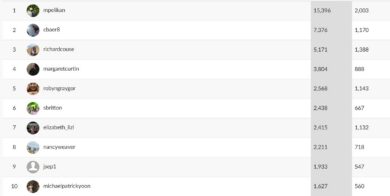
A roughly similar patter will, I expect, always be evident, as observers vary in their enthusiasm, their skill, and the amount of time they spend in the field. But every single observation is valuable, helping clarify our understanding of the biodiversity of Martha’s Vineyard. And it appears that the distribution of contributions is growing steadily less lopsided as more and more observers build their skills and start entering data routinely.
Finally, remember that the observations entered into iNaturalist are only as useful as their identifications are correct. The artificial intelligence built into iNaturalist, which matches observation images with a catalog of species the AI has “learned” to identify, is a handy and helpful feature. But it’s imperfect, quite accurate with some taxonomic groups but prone to egregious misses in others, and the iNaturalist community relies on the generosity of thousands of experienced observers who share their hard-earned knowledge by providing identifications. More than 5,100 such contributors have helped maintain the quality MV Atlas of Life data so far. The list of most active identifiers is led handily by local botanist Margaret Curtin, whose knowledge of local plant life is exceeded only by her willingness to share that knowledge. Her work on the behalf of the MVAL project — her identifications as well as the observations she’s submitted — are a constant reminder of the collaborative spirit and sheer rejoicing in the natural world that are at the heart of iNaturalist and the MV Atlas of Life.

So while it’s a nice, round number and a convenient milestone, the figure of 6,000 species is more of a beginning than an end. The sky is the limit for the future, as a worldwide community of scientists and amateur naturalists touches down on this odd and distinctive island. Thanks to everyone who has helped get us this far!
Matt Pelikan is the community naturalist at BiodiversityWorks. An Oak Bluffs resident since 1997, he is a dedicated iNatter and an enthusiastic student of all types of plants and animals.