

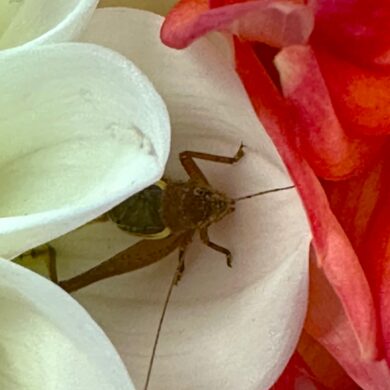
Male prairie meadow katydid, Conocephalus saltans, photographed by Sharon Britton on August 6, 2026.
New Orthoptera Species for Martha’s Vineyeard
Orthoptera — grasshoppers, crickets, and katydids — are one of the better known groups of insects on Martha’s Vineyard. Beginning in 2010, I’ve drawn on historical sources, my own fieldwork, iNaturalist data, and reports from other observers to produce a local checklist for this taxonomic order. You might think that with that level of sustained effort, such a checklist would have achieved a measure of stability. In fact, though, new species continue to be added, some clearly new arrivals and others apparently species that have been here along, undetected, until the present day.
The rate of addition of new species to this checklist has slowed two an average of one or two species per year, which you would expect as fewer and fewer plausible possibilities remain to be found here. So it is remarkable that the second half of the summer of 2026 saw a total of four new Orthopteran species documented on the Vineyard, in the space of just a few weeks. These new additions bring the Vineyard Orthoptera checklist up to a remarkable 77 species.

Eastern ant cricket, Myrmecophils pergandei, photographed on July 26, 2026, by Chris Baer.
The first in this remarkable series of records as the island’s first eastern ant cricket, Myrmecophilus pergandei, which was photograhed by Chris Baer on July 26, 2026. This small, flightless species belongs to an atypical family within Orthoptera, with small eyes and devoid of hearing organs, adapted for life as kleptoparasites in subterranean ant nests. Broadly distributed across the eastern United States, M. pergandei is infrequently observed because of its secretive habits; for all I know, it may actually be a fairly common insect. It seems probable that this species has been present but unnoticed on Martha’s Vineyard for a long time. Given its habits, it is not likely to be very mobile on its own, and it is not a good candidate for accidental transport by human activity. So its presence on the Vineyard likely dates back to the distant past, when a post-glacial Martha’s Vineyard was still connected to the mainland as a result of low sea levels. This species was another in a long list of interesting discoveries Chris has contributed.


The next species to be added was the small katydid Conocephalus saltans, also known as the prairie meadow katydid. Broadly distributed across the United States and southern Canada east of the Rocky Mountaints, this insect is scarce in New England, known from just a few scattered locations in Massachusetts. Among North America’s Conocephalus species, C. saltans is taxonomically distinct, often put in its own subgenus by virtue of having only two apical tibial spines (vs. the three that are normal in this genus). But saltans is quite similar to C. strictus, the straight-lanced meadow katydid, which is common and widespread on Martha’s Vineyard. In particular, both species feature extremently short wings (at least usually: long-winged variants of both species occiasionally occur). Differences include the ovipositor length and shape (shorter, more curved, and more blade-like in saltans) and, on males, the length and shape of the cerci (shorter in saltans with a more prominent hook). C. saltans is also typically pinkish or brownish in coloration, different from the green of C. strictus.
A small katydid photographed by Sharon Britton on August 6, 2026, eventually proved to be the Vineyard’s first record of this species. Found in West Tisbury and entered into iNaturalist, this individual, a male, appeared by be final-instar nymph. C. saltans was first proposed as an identification by iNaturalist user Gracie Catanzaro, but Orthoptera nymphs can be hard to identify, and some uncertaintly remained about this individual. I followed up a month later, visiting the same site in the hope of finding fully mature individuals, and photograped both male and female adult saltans — a development that supported Gracie’s earlier identification.
Like Myrmecophilus pergandei, nearly wingless Conocephalus saltans is a poor candidate both for human-aided transport and for long-distance dispersal under its own power. It seems likely that the species has long been present on Martha’s Vineyard, but in numbers low enough so that it evaded detection. Interestingly, the presence of Conocephalus saltans on the Vineyard was predicted more than a century ago by the entomologist Albert Morse. Reporting the presence of this species in modest numbers on Nantucket (but nowhere else in the region) in his 1921 Manual of the Orthoptera of New England, Morse presciently urged that Martha’s Vineyard and upper Cape Cod be searched for additional occurrences. He was right!
A well-timed dinner engagement produced the third new Orthoptera species found during this period. Leaving a friend’s house in Vineyard Haven on the evening of August 20, I was greeted by a loud Orthopteran call that I initially misidentified as coming from a snowy tree cricket (Oecanthus fultoni). That cricket is uncommon enough on Martha’s Vineyard so that I record it whenever I get the chance, so I zeroed in on the song with my cell phone’s voice recorder application recording. While the pulsed call and tone quality of the song truly did remind me of O. fultoni (though perhaps they shouldn’t have!), I was puzzled by the point of origin of the call: from ground level, rather than in vegetation a few feet off the ground, where one expects to find tree crickets. The next morning, using on-line references, I identified the puzzling call as belonging to a Japanese burrowing cricket, Velarifictorus micado. The identification was quickly confirmed in iNaturalist.
There is no evidence that this species, exotic as its common name suggests but established across most of the eastern United States, has an established population on Martha’s Vineyard. But the species has been growing more common in densely settled areas of Massachusetts, and its arrival as in accidental import on Martha’s Vineyard was probably inevitable. If not established here yet, it probably will be in the near future.
Finally, another long-expected Orthopteran species was documented on the Vineyard on September 11, 2026, when a a restless bush cricket (Hapithus agitator) was photographed by iNaturalist user bunnyhollow. Easily distinguished from the related jumping bush cricket, H. saltator, by its pale wing edges, H. agitator is one of a number of native Orthoptera that are expanding their ranges northward through southern New England, presumably in response to climate change. This individual reportedly originated in a flower garden on East Chop, in Oak Bluffs. Whether it was present there as an accidental import or as part of a newly established population is not clear, but as with Velarifictorus, the arrival of H. agitator on Martha’s Vineyard seemed certain to occur at some point, and having arrived here, the species will likely become established.
Taken together, these new local records illustrate several important points about Orthoptera. First, species in this group can persist for long periods of time without being detected, as Myrmecophilus pergandei and Conocephalus saltans apparently did. Second, many species in this order are surprisingly capable of dispersing long distance, even across expanses of water such as the one that separates Martha’s Vineyard from the mainland. While the most mobile species are capable of moving themselves around, human commerce and travel can be an effective means of dispersal even of flightless or weak-flying species such as bush crickets. A third point follows from these two: despite sustained study of Orthoptera on Martha’s Vineyard, the final word has yet to be written. Between overlooked species and new arrivals both natural and human-aided, the Vineyard’s Orthoptera checklist is still in flux, and this is a group of insects that naturalists on the island should be alert for.
Matt Pelikan is the community naturalist for BiodiversityWorks. He is an ardent student of Orthoptera and a committed user of iNaturalist. He has lived year-round in Oak Bluffs since 1997.