
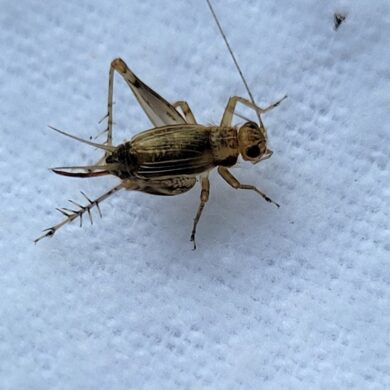
Say’s Trig and Columbian Trig Documented on Martha’s Vineyard
The Martha’s Vineyard Orthoptera checklist expanded to 71 species in September with the documention of two expected but elusive species: Say’s trig (Anaxipha exigua) and Columbian trig (Cyrtoxipha columbiana). Both of these small crickets have been steadily increasing their distribution in southern New England, and their appearance on Martha’s Vineyard was probably inevitable.
Members of the cricket family, these trigs differ from many of their relatives in preferring arboreal settings to life at ground level. Say’s trig is a denizen of low, dense shrubbery; Columbian trig is often found higher up in lower portions of the tree canopy.
With a range that covers much of the eastern United States, Say’s trig is well established in settled areas of Massachusetts, with a smattering of records north into Vermont, New Hampshire, and southern Maine. A tiny, brownish cricket with prominent spines on its hind tibia, this species is, like most of its relatives, secretive and easier to hear than to see. (You can hear examples of its song on the Singing Insects of North American website.) An adult female was found by a BiodiversityWorks team conducting fieldwork in Vineyard Haven on September 16, 2025.
A member of the same genus, Anaxipha, was entered into iNaturalist on November 1, 2024, by Greg Palermo, who photographed the insect in Edgartown. While the genus of this individual is certain, its specific identity is not. A. exigua seems mostly likely, but one Orthoptera expert considers the closely related A. tinnulacita as a possible identification. So it’s possible that we have two members of this genus on Martha’s Vineyard, which would bring the checklist total to 72. The origins of neither this individual nor of the Anaxipha photographed in Vineyard Haven can be positively determined; they could reflect established but previously undetected populations, or they could be one-off, accidental imports. Regardless, their locations in densely settled areas likely reflect arrivals by means such as transport on landscaping material or by clinging to cars, either of which could be effective means of long-distance dispersal for this species.
The same applies to Columbian trig, Cyrtoxipha columbiana, which was recorded singing near downtown Oak Bluffs on September 20. Subsequently, I’ve heard a number of individuals calling in the same general area, suggesting the presence of an actual population. Somewhat less far along in the colonization of New England than Say’s trig, this attractive, greenish species appears largely restricted at present to the “heat islands” of Boston and Providence, and the mild Connecticut River Valley. But its expansion seems likely to continue, and like Say’s trig, the appearance of Columbian trig on the Vineyard seemed like just a matter of time.
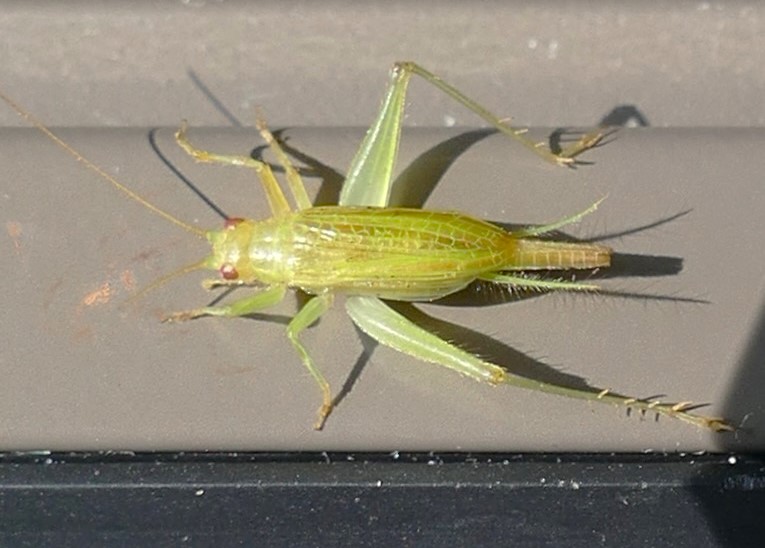
Columbian trig (Cyrtoxipha columbiana) photographed by iNaturalist user llsrvd (https://www.inaturalist.org/photos/570573366)
It’s possible, indeed likely, that these species are also present elsewhere on the Vineyard, and both species can be expected to grow in numbers in the coming years. And another trig species, Phyllopalpus pulchellus, can be expected to turn up here and indeed may already be present. These cases are a reminder that the Vineyard’s insect fauna is in constant flux, and that even species such as tiny, weak-flying or non-flying cricket species can exhibit amazing abilities to disperse to new locations.
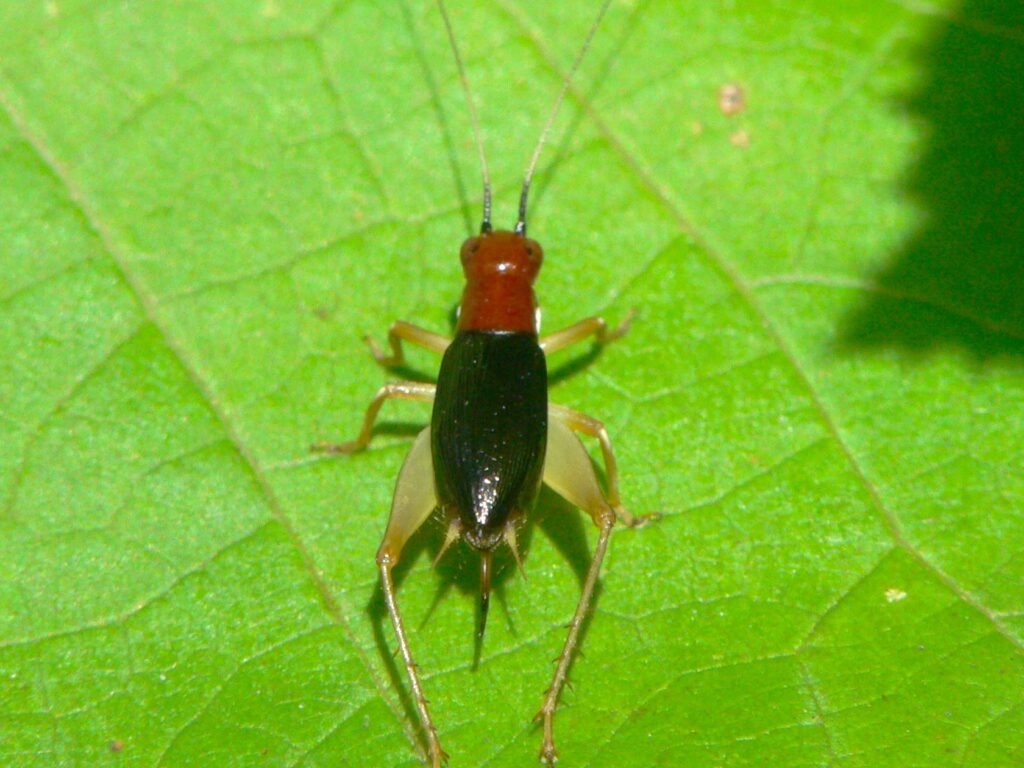
Next to be discovered on the Vineyard? A female Phyllopalpus pulchellus.
Matt Pelikan is the community naturalist at BiodiversityWorks. He has been studying the Orthoptera of Martha’s Vineyard since 2010, an interest prompted when he noticed nymphs of the grasshopper Chortophaga viridifasciata cheerfully hopping around his yard in mid-February.