

Entomobrya katzi, by Chris Baer
Springtail Season
The colder months — let’s say late October through the end of March — represent a tough period for a lover of invertebrates on Martha’s Vineyard. To be sure, a skilled observer can almost always find something: quite a few arthropods routinely linger into winter in modest numbers, and a few species, such as the winter crane flies, center their life cycle in fall and winter. But if you’re hoping to find cold-blooded animals of any kind, winter is decidedly the off-season.
But the springtails stand out as a bright spot during this period. Hardy lovers of moist settings, these odd and sometimes abundant arthropods have not been systematically studied on the Vineyard. But what data are available suggest that cold weather barely dims their enthusiasm. In recent months, island iNaturalist observer Chris Baer has done a spectacular job documenting the springtails on the island. Of the current (when this post was published) total of 133 Vineyard iNat observations of Collembola, Chris has accounted for 104 — a major contribution, community science at its best. Observations from Chris and others span the full year, and it’s evident that springtails can be readily found here, even in large numbers if you know how to look, through even the roughest winter weather.
The Collembola are odd beasts by any measure. Bugguide still treats this group as a full taxonomic class under the subphylum Hexapoda; the taxonomy used by iNaturalist, which appears to be more current, treat this group as a sub-class nested in the the class Entognatha. Regardless, springtails are insect-like but quite distinct from insects. The main claim to fame of this group is the furcula, a forked structure tucked under the abdomen that can be put under tension and then released, throwing the springtail into an impressive but seemingly untargeted leap. The helpful Bugguide account for the class (or sub-class) notes that the furcula and other structures of springtails vary with life histories, with more fossorial species exhibiting reduced eyes and furculas, or sometimes even lacking these items altogether.
There are four generally recognized orders of springtails, with two of these accounting for the vast majority of Vineyard observations: Entomobryomorpha, the “elognate springtails,” and Symphypleona, the “globular springtails.” Especially prominent in our springtail fauna is the genus Dicyrtomina (notably D. ornata), in Symphypleona. Among the elongate springtails, the genus Entomybria appears most common and widespread. As you’d expect from a group that is small, cryptic, and difficult to photograph, a good percentage of the island’s springtail observations are not yet identified to species level (a few even linger as just “Collembola”). But iNat’s artificial intelligence works fairly well at getting springtails at least to genus, and the Vineyard has been the beneficiary of excellent identification work by several experts, especially Timothy Lindsey (user name “macrotim“) and Josiah Smith (user name “jjwsphotography“).

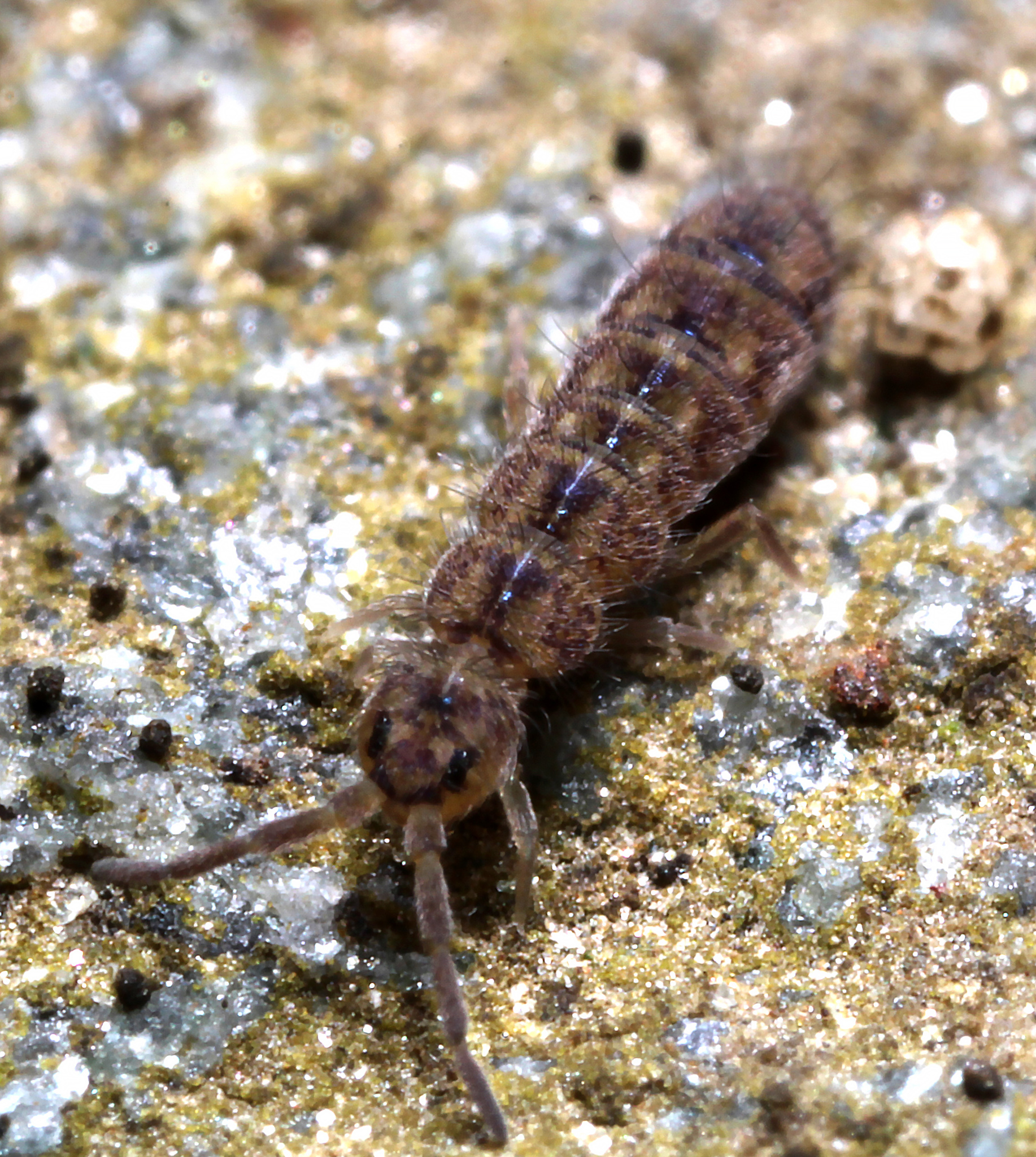
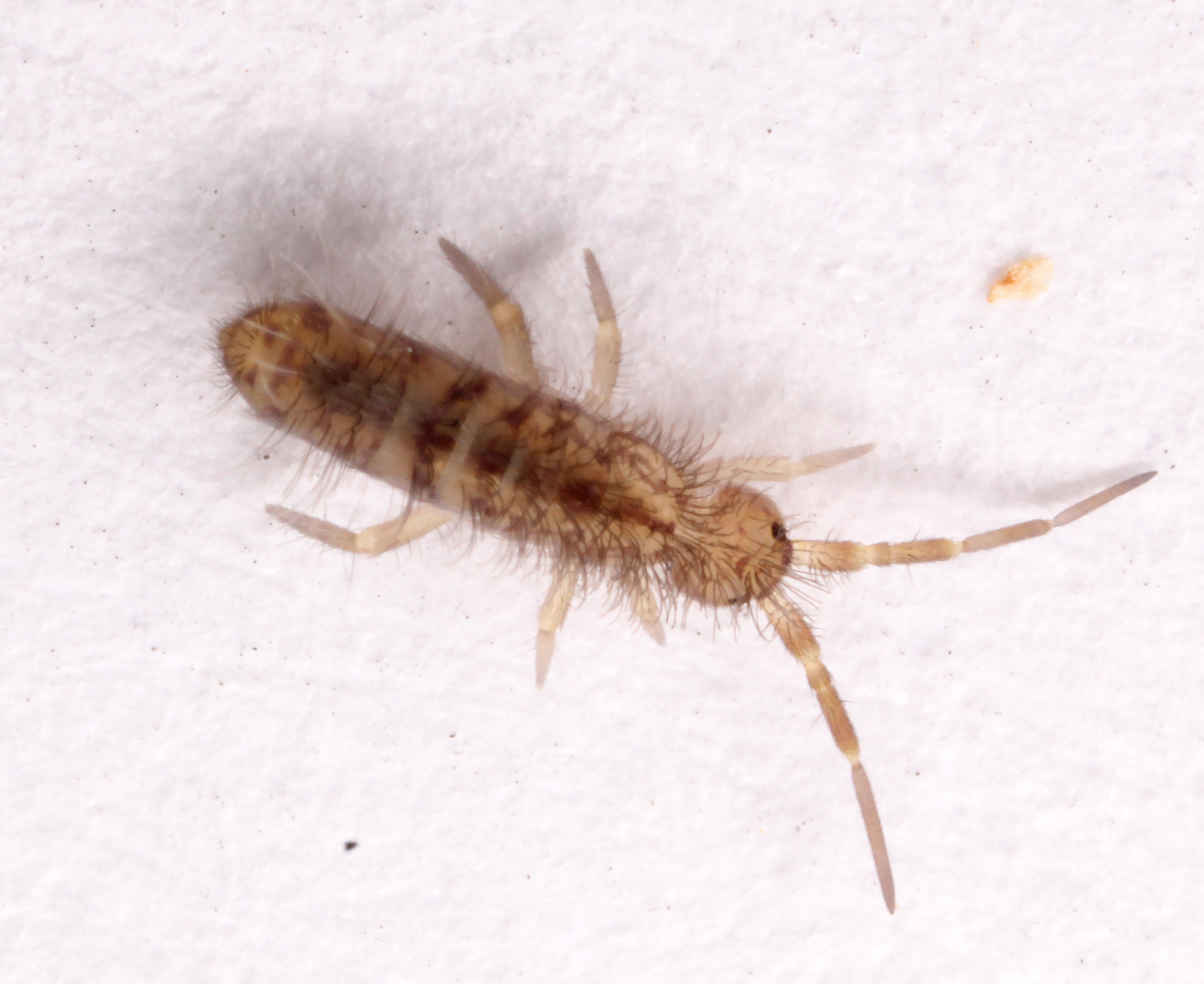
With about 8,200 species worldwide, according to Bugguide, Collembola is a fairly diverse group, and it seems certain that the eight Vineyard species identified to the species level in iNaturalist represent just a fraction of the island’s true diversity of this group. (A broader count, including non-“Research Grade” identifications — unconfirmed IDs or IDs stuck at genus-level or higher — raises the tally to 19 species, and even that, I expect, is low.) So additional springtail observations would be very useful. Look for these hexapods in damp settings of all kinds. Dicyrtomina, and possibly other globular springtails, turn up regularly on porch railings at the BiodiversityWorks office on mild but damp days in late fall and early spring. A few springtails can be found, sometimes in vast numbers, on the surface of snow, though the classic “snow flea,” Hypopgastura, is only represented by one Vineyard observation.
Springtails of all kinds can be found by rummaging in moist leaf litter. They are primarily detritivores, eating damp and decaying organic material; Bugguide notes that some species eat fungal spores, and also that “[m]ales use their prehensile antennae to hold onto female antennae when mating.” Springtail photography is challenging; these are small, very active arthropods, and a camera flash setup to raise shutter speed is nearly essentail for good results. But even mediocre photographs can often by identified to family or genus, and the study of this group on Martha’s Vineyard is a subject to which any active naturalist can usefully contribute.
Our header image is Tomocerinae sp., beautifully photographed by Chris Baer. Thanks to Chris for his splendid work on this group, and thanks as well to the iNaturalist identifiers who have helped improve our data.
Matt Pelikan is the community naturalist for BiodiversityWorks. A year-round Oak Bluffs resident since 1999, he is an avid birder, insect-watcher, and iNat user.