
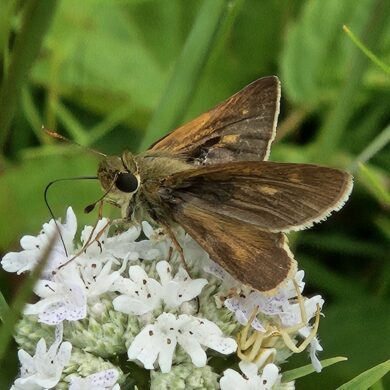
Wallengrenia egeremet. Photo: Rich Couse
2026 Correllus State Forest Bioblitz
Running from 5:00 p.m. on Friday, July 17, through 5:00 p.m. on Saturday, July 18, the fourth annual Correllus State Forest bioblitz compiled the most observations and the most species ever recorded on a one-day bioblitz on Martha’s Vineyard. As this is written, the totals stand at 1,061 observations and 382 species. (The iNaturalist project for the event, which will continue to evolve as identifications are improved or corrected, appears here.)
These results are all the more impressive in that only 11 observers submitted data to iNaturalist (no better than average for a Vineyard bioblitz), and that the weather deteriorated steadily from a great start on Saturday, suppressing insect activity and eventually shutting fieldwork down with a band of rain.
We did, though, enjoy ideal weather for blacklighting for moths on Friday night. And the bioblitz enjoyed an unexpected boost from the coincidental arrival of UMass/Boston moth expert Teá Montagna and a small team of biologists in Correllus for a previously planned research visit. Their expertise and three powerful light arrays added hugely to our mothing effort.
As is usual with bioblitzes, which deploy multiple observers in an intense survey effort, a number of significant finds figured in the results. Observers who stuck with Friday evening’s mothing event until about 10:15 were rewarded with not just one, but two imperial moths, Eacles imperialis. The Massachusetts distribution of this spectacular insect is currently limited to Martha’s Vineyard and the upper Cape Cod:
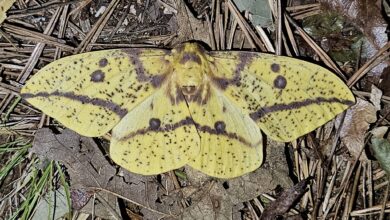
Eacles imperialis. Photo: Rich Couse
Among the interesting insects found by Chris Baer were the Vineyard’s first iNat observation of a Phorid fly in the genus Megaselia (below, left) and our second observation of the ant-like flower beetle (Anthicidae) Anthicus cervinus (below, right):


Focusing primarily on recording insects, I experienced the event as a rather slow day in the field. A number of groups that I expected to be plentiful were in fact scarce: the small katydids in the genus Conocephalus, for example, or bees, or butterflies except for dun skipper (Euphyes vestris), which was fairly common. There were numerous periods during the day of five or ten minutes during which I didn’t find anything that merited photographing. Since conditions during the first part of the day were good for insect-hunting, I surmise that the harsh conditions of last winter, a rather droughty spring and early summer, or a combination of the two may have suppressed numbers of a lot of types of insects. This would be consistent with my generally underwhelmed impression of this field season as a whole. Every year is different.
Still, I managed to submit my highest-ever single-day number of observations, and along the way I found a few unusual species and had a lot of fun. My favorite personal observations were three I made of the colorful Syrphid fly Microdon fulgens (I spotted a fourth individual but was unable to photograph it). The geographic distribution of this curious fly, with a population centered in the deep southeastern United States, makes the Vineyard population significant. (I’ve written about this species in a previous blog.)
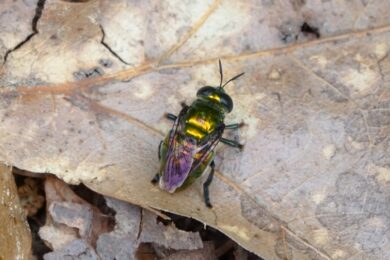
Microdon fulgens. Photo: Matt Pelikan
Correllus State Forest, which is owned and managed by the Massachusetts Department of Conservation and Recreation, is renowned for its biodiversity and ecological importance. Its rare sandplain barrens habitats make it a hotbed of rare plants and insects, most notably Lepidoptera. Our bioblitzes of this property, which have evolved into an annual tradition, have proven to be a fun way to celebrate and document this exceptional resource. For more information about Correllus bioblitzes, click the buttons below! And we hope you’ll join us in 2027.
Matt Pelikan is the community naturalist for BiodiversityWorks. A year-round Vineyard resident since 1997, he is a versatile naturalist and an enthusiastic bioblitzer.