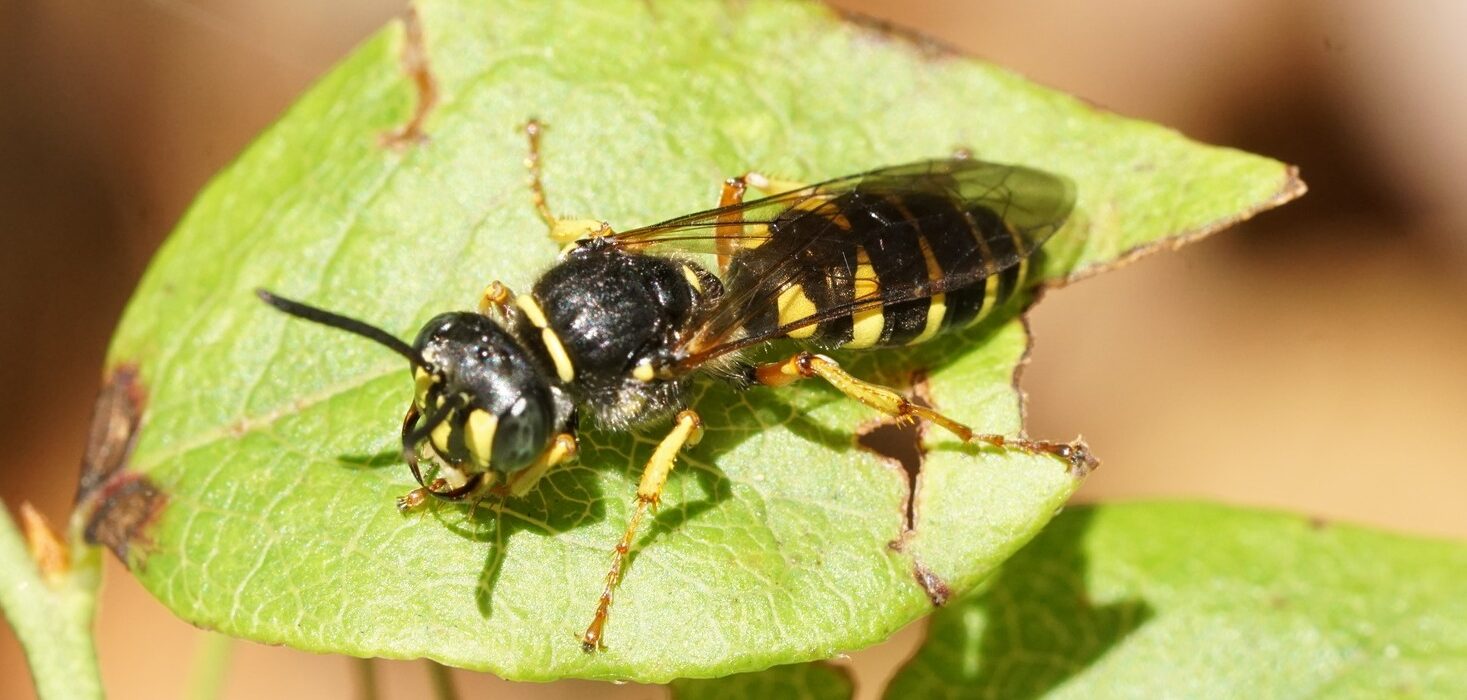
Crabronidae
This large, interesting, and ecologically important family figures prominently in the Vineyard’s insect fauna, with some very common members and some very conspicuous ones. The actual diversity represented here, however, so far appears to be rather low. Bugguide.net reports almost 100 genera of this family in North America, and more than 1,200 species, yet at present our local checklist contains just 29 species. The diversity of this family on Martha’s Vineyard, however, is surely higher, and we expect this list to grow steadily as more data become available and resources for identification improve. Five subfamilies are represented on our checklist, and 20 genera.
Nested in the superfamily Apoidea, Crabronids are closely related to (and were formerly lumped with) the Sphecid wasps. Both families comprise mostly ground-nesting wasps that provision their nests with paralyzed prey; typically there is some measure of specialization in these predator/prey relationships, with a particular wasp species normally predating members of particular family or genus. Among the Crabronids, Bugguide lists a wide range of insects as preferred prey: “aphids, bees, beetles, bugs, butterflies [and] moths, cicadas, cockroaches, crickets, flies, grasshoppers, hoppers, mantids, and spiders.” Adult Crabronids often visit flowers to feed on pollen or nectar. Searching flowers is a good way to find members of this family, though their nests, often prominent, round burrows surrounded by a tumulus of spoil, can also be conspicuous.
Crabronids are also closely related to bees (the epifamily Anthophila), which are generally accepted to have descended from Crabronid ancestors. The details of this relationship are not fully known, but it’s reasonable (and kind of fun) think of bees as Crabronid wasps that have adopted a fully vegetarian lifestyle and evolved anatomical features, such as pollen-carrying hairs, to support that lifestyle. In any event, given this relationship, it is not surprising that some Crabronids are quite bee-like in appearance (and indeed some bees resemble Crabronids). As is the case with a lot of insect groups, the taxonomy of Crabronidae is constantly changing, with some recent work elevating most of the family’s subfamilies to full family status.
Our checklist is based mainly on “Research-Grade” observations from the iNaturalist platform. For genera for which there are no such confirmed, species-level observations, we have included the genus; for a few genera, such as Gorytes, we included placeholders for multiple species that appear to us to be distinctive but have not yet been identified. In a few cases, e.g., Ectemnius, we have included hypothetical species for which we don’t have confirmed identification but which are clearly different from full species included in the checklist. The “Comments” column of the checklist captures some other information on possible but as yet unconfirmed species. Our goal, in other words, has been to give as complete a picture of the Vineyard’s Crabronid diversity as present knowledge allows.
A valuable resource for studying wasps of all kinds in our region is Holm 2021. This large and opulently produced volume offers a good overview of wasp taxonomy and biology was well as excellent family-level treatments that include identification details for many of the wasp species you’re mostly likely to encounter. An emphasis throughout on ecological relationships makes this volume especially interesting. Also helpful is Eaton 2021, which oriented less toward identification but goes into more detail than the Holm book does on biology and behavior.
Matt Pelikan, edited July 24, 2026
References:
Eaton, E.R. 2021. Wasps: The Astonishing Diversity of a Misunderstood Insect. Princeton, NJ: Princeton University Press.
Holm, H. 2021. Wasps: Their Biology, Diversity, and Role and Beneficial Insects and Pollinators of Native Plants. Minnetonka, MN: Pollination Press LLC.