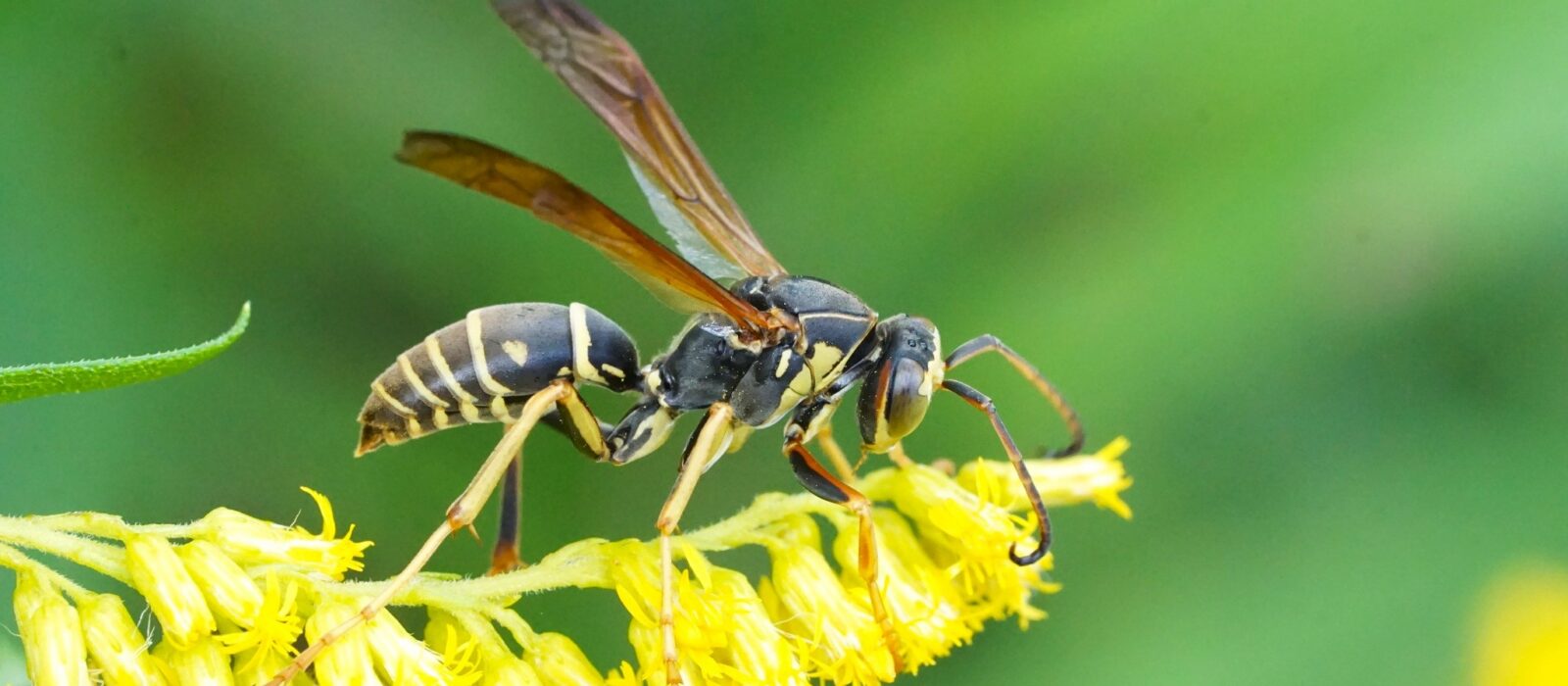
Vespidae: Potter Wasps, Paper Wasps, and Yellowjackets
This important subfamily contains the wasp species that will be most familiar to the general public: in particular, it includes the social wasps that are familiar for their conspicuous nests and powerful stings. Of these, the subfamily Polistinae contains the paper wasps, of which only two species have been solidly documented on the Vineyard, and the somewhat more diverse yellowjackets of the subfamily Vespinae. The third Vespid subfamily represented on Martha’s Vineyard, Eumeninae, comprises the potter and mason wasps — solitary nesters that either construct nests or use holes as their nest sites. In all, the present checklist inclues 11 genera and 27 species, with one of those species included as hypothetical.
The reputation of the members of this family for having powerful stings is not wrong. But their reputation as aggressive needs a little qualification. The social members of Polistinae and Vespinae are indeed zealous in defense of their nests (though at least anecdotally, the Polistinae in paritcular may have some ability to grow accustomed to human presence, rendering them somewhat more tolerant). And all members of this family, like virtually any animal, will defend themselves if they consider themselves seriously threatened. But the Emeninae are much less defensive of their nests, and members of this family in general are pretty mellow insects when they are out foraging and away from their nests. One should certainly treat all Vespids with respect, and individuals with an allergy to wasp stings should of course be very cautious around these insects. But “aggressive” is not really a word that can fairly be applied to these wasps; if you don’t bother them, they won’t bother you.
Vespids play important ecological roles. Adults of most species feed mainly on vegetable food like nectar and pollen, and so it is no surprise to find Vespids of all stripes visting flowers and hence functioning as pollinators. In Eumeninae, adults provision their nests with paralyzed prey items, and in general there is some degree of specificity in the prey that each wasp species will take. Laval paper wasps and yellowjackets are fed predigested animal matter, often carrion or other insects. Due to these predatory habits, Vespids play imporant roles regulating populations of other arthropods.
Our checklist was compiled mainly from “research grade” iNaturalist observations. We have included a few species for which there are not (yet) any confirmed observations but for which, in our own judgment, solid enough records exist to merit inclusion. One species, Polistes parametricus, is included as a hypothetical: the distribution of this species and how it is distinguished from P. fuscatus are open questions, and some Vineyard individuals look enough like parametricus to us that we felt it was worth including this species in the list.
Like all of our checklists, this one should be considered a work in progress and can be expected to grow with time. There are surely more Eumeninae out there awaiting discover, and possibly species in our other Vespid subfamilies, as well. And forces such as climate change and the movement of insects by means of human transportation and commerce seem likely to bring new species to the island in the future. So this interesting and important family merits sustained attention from naturalists.
A valuable resource for studying wasps of all kinds in our region is Holm 2021. This large and opulently produced volume offers a good overview of wasp taxonomy and biology was well as excellent family-level treatments that include identification details for many of the wasp species you’re mostly likely to encounter. An emphasis throughout on ecological relationships makes this volume especially interesting. Also helpful is Eaton 2021, which oriented less toward identification but goes into more detail than the Holm book does on biology and behavior.
Matt Pelikan, July 24, 2026
References:
Eaton, E.R. 2021. Wasps: The Astonishing Diversity of a Misunderstood Insect. Princeton, NJ: Princeton University Press.
Holm, H. 2021. Wasps: Their Biology, Diversity, and Role and Beneficial Insects and Pollinators of Native Plants. Minnetonka, MN: Pollination Press LLC.